

How Did The Middle Ages Makeup
Medieval cosmetics and beauty routine
When you lot imagine a medieval homo or woman, what do you see? Foul teeth? Greasy hair? Dirty, bumpy peel? Hairy armpits and sweat stench?
Well, for some of them, this might have been true. For some people today, this is still true. But medieval sources prove, that information technology could be and has been dissimilar for large parts of the population. Medieval people know far more than we think today.
In this article I want to talk almost aspects of (female) beauty routine and cosmetics, as nosotros notice them in medieval sources (mainly the Trotula).
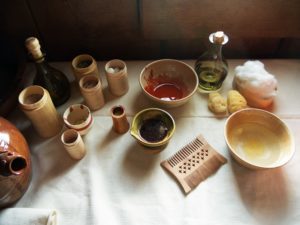
Concerning all the recipes I mention: I slightly changed some of them since many of them do their job in their original mixture simply on a long term utilise will touch on your health quite badly. Others are working with 3 usefull ingredients and one absolutely cool ingredient, which does not contribute to the outcome in whatever way and of which I can non say, whether it is in the recipe due to faulty copying the original texts, due to superstitious reasons or simply because the writer had no clue.
Too I simply left out a whole bunch of recipes which seemed to have no noticable use or impact from a modern point of science.
The daily morning routine equally described in some of the texts nosotros documented in this video:
The subject areas:
- Daily wash
- Deodorant
- Hair intendance
- Hair removal
- Dental hygiene
- Nailcare
- Ear spoons
- Decorative cosmetics
- Sun screen
- Jewellery and clothing
- Further data
Daily wash
The crude basics: Bathing was not a daily habit in tardily medieval fourth dimension. Simply the same goes for almost of guild up until the 50s. A quick bathroom with hot water and a sponge or washcloth was sill common in my grandmother's time. Medieval people visited the bathhouse maybe once or twice a week. Nosotros explain a thing or ii virtually Viennese bathroom houses in our video „In the bathhouse" and in Nikolaus' accompanying commodity.
For daily aseptic routine, the Trotula suggest to their female readers, to wash the torso with cloth or sponges and accept a steam bath.
„Take called-for hot tiles and stones and with these placed in the steambath, let the woman sit in it. […] Then let hot water be poured in then that steam is produced, and permit thewoman sit upon information technology well covered with cloths then that she sweats. And when she has well sweated, let her enter hot water and wash herself very well, and thus permit her exit from the bath and wipe herself off well with a linen cloth."
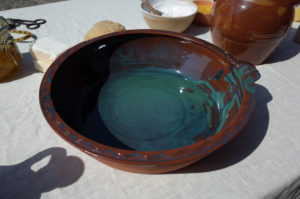
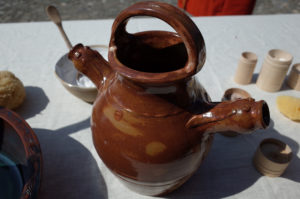
For washing, often a washbowl and a jug was in use.
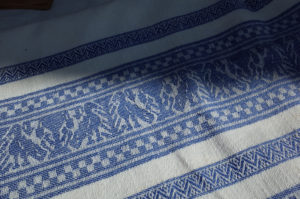
Towels were in employ to dry the torso. Nosotros know this from many finds and original pictures of medieval towels in their very feature shawl-like grade featuring woven-in bluish or black stripes. Especially famous are italian Perugia-Towels and their cute blue and white patterns.
The face gets special attention in the Trotula. You are supposed to wash your face with french soap and and then practice a face scrub with wheat bran. Something you still do today. Wheat bran is a nice alternative to modern peeling lotions containing nasty microplastics.
„ First of all, permit her wash her face very well with French soap and with warm h2o, and with a straining of bran allow her wash herself in the bath."
By the way, they as well mention a face mask fabricated with wheat starch. Likewise something still done today .
After washing the face, thorough skin care is necessary, so our lady uses a delicate hydrating cream after a recipe from the roman physician Galien. Why a roman recipe? Considering Galien's works are still taught in the Viennese Academy in mid 14th century.
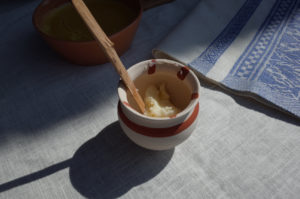
It is fabricated from bees wax, rose oil and almond oil and feels really nice on the skin.
On her temples, our lady wears a flake of violet-ointment against headaches.
Deodorant:
So now that we are all fresh and make clean, we want to proceed information technology that way. And the Trotula also offer a recipe for that purpose:
„There are some women who take sweat that stinks beyond measure. For these nosotros prepare a cloth dipped in wine in which there take been boiled leaves of bilberry"
We don't know, how exactly this deodorant is supposed to work. We recall it might be due to the antibacterial properties of the wine and the adstringent tanning agents in the bilberry leaves that crusade the pores to tighten. So it may very well be a solution for a few hours.
Hair care:
To launder the hair (which certainly was not washed every 24-hour interval), lye from ash was near probable used. The Trotula mention ash from vie stems to launder the pilus.
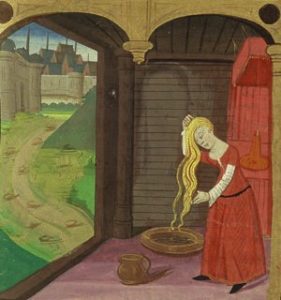
„Afterward leaving the bath, let her adorn her pilus, and first of all allow her wash information technology with a cleanser such as this. Take ashes of burnt vine, […] eddy the chaff and the sowbread in water. […] Allow a pot having at its base ii or three small openings exist filled. Permit the water […] be poured into the pot, then that information technology is strained by the small openings. With this cleanser let the woman wash her caput. After the washing, allow her leave it to dry out by itself, and her hair will be golden and shimmering."
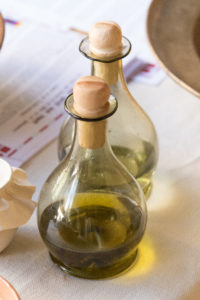
Afterwards, some medieval conditioner can be used, in the original recipe this is made from lizzard grease and some nice smelling substances. But fifty-fifty if you lot could get the lizzard grease, it would not practise any meliorate piece of work than any other kind of oil or grease to make the hair shiny and healthy. We used olive oil, spiced with lemon peel.
To make the pilus smell fifty-fifty nicer, yous can employ this hair powder:
„But when she combs her pilus, allow her have this powder. Have some dried roses, clove, nutmeg, watercress, and galangal. Let all these, powdered, be mixed with rose water. With this water permit her sprinkle her hair and comb it with a comb dipped in this same h2o and then that it will smell better."
The pulverization smells really nice and kind of oriental. Every bit a modernistic homo, even I could imagine smelling like that occasionally.
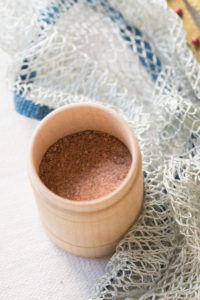
And you lot can do even more to leave a lovely smell in the air your beloved smells when you walk past:
„Also, noblewomen shouldwear musk in their hair,or clove,or both, but take care that information technology non be seen past anyone. Also the veil with which the head is tied should be put on with cloves and musk, nutmeg, and other sweet-smelling substances."
More almost hair care and hair styles here.
Hair removal:
Concerning the rest of the body pilus, the hairless body was not unknown to medieval people.
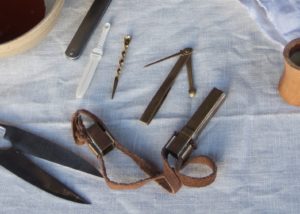
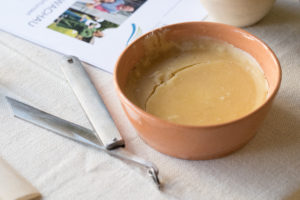
A adult female would apply tweezers to remove unwanted facial hair or even use a medieval variation on modern waxing.
„Take Greek pitch and wax, and deliquesce them in a clay vessel. And these things having been dissolved, let a small driblet of galbanum be added, [and] let them melt for a long fourth dimension, stirring with a spatula. Likewise, take mastic, frankincense, and gumarabic, and let them be mixed with the residuum. Having done this, let it be removed from the burn down, and when information technology is lukewarmlet her smear her face up; only permit her accept care [not to touch] the eyebrows. Let her leave it on for an hour until it becomes cold. Then permit her remove it. This refines the peel and makes the face beautiful, and it removes hairs and renders every blemish well colored and articulate."
Then you mix wax with different resins and gums and employ information technology as hot as possible to your skin. Surprisingly, some modern waxing mixes are nonetheless made from wax and resins. Nosotros did still non attempt this recipe for obvious reasons :-)
But also leg and pubic hair was removed. We can see different methods for that. Of course, you can shave it, as seen in this relief from the 13th century. But you could too tweeze the hair when your pores are open, for example after a steambath.
„ In order that a adult female might become very soft and smooth and without hairs from her caput down, beginning of all let her go to the baths, and if she is not accepted to practice then, let there be made for her a steambath in this manner."
Later yous have to rub your body thoroughly with towels and pinch out the pilus.
It might exist quite a flake more than pleasant to use depilatory cream though. The aboriginal and medieval version of that is rhusma turcorum . The mixture consists of (quick)lime and orpiment, has been already known in antiquity and is still in employ in regions of Republic of india today.
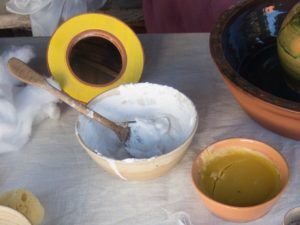
„ Later on let her likewise bless herself all over with this depilatory, which is fabricated from well-sifted quicklime. Place three ounces of it in a potter's vase and cook information technology in the manner of a porridge.And so take 1 ounce of orpiment and cook it again, and test information technology with a plumage to run into if information technology is sufficiently cooked."
And your hair is going to fall out for sure due to the very aggressive ingredients. The lime practically disolves some of the hair, orpiment is toxic. So please NEVER attempt this at home, just use modernistic and safety depilatories! Even medieval people knew that the utilize was unsafe for the skin and put a recipe for burnt skin from this depliatory correct after this recipe.
„Take intendance, still, that it is not cooked too much and that it not stay besides long on the peel, because it causes intense estrus."
More about historical hair removal hither.
Dental hygiene:
Teeth are not left to rott in medieval times. They were cleaned with the available ways as well every bit possible. There are some recipes for tooth powders, most of them incorporate stone flour, spices and table salt, but too grind walnut shells or charcoal are possible ingredients. With a damp material, the powder is picked up and used to rub the teeth.
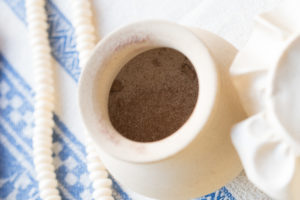
„As well in order to make black teeth white, accept ten drams of roasted pumice,ten drams of salt,two drams each of cinnamon and cloves,and honey every bit needed. Mix the pumice and salt with a sufficient amount of honey, and place them on a manifestly dish upon coals until they burn, and reduce the other spices to a powder. And when there is demand, rub the teeth."
Tooth powder like this is yet in use today, though much effectively and less likely to damage your dental enamel.
Nail care:
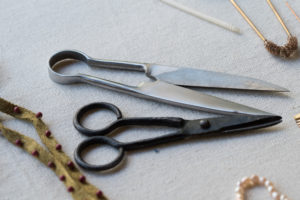
And of course, nails are regularly clipped with scissors similar in this picture from the Lilienfeld chronicles and they are cleaned with the nail cleaner which is part of almost every extant hygiene set.

Earspoons:
I am mentionning it scince the earspoon was a very common particular. Only nosotros have non tried this tool for the beloved of our eardrums.
Decorative cosmetics:

Since there are several paragraphs in the Trotula that would extend the scope of this articl, I will simply describe what I reconstructed.
Face white:
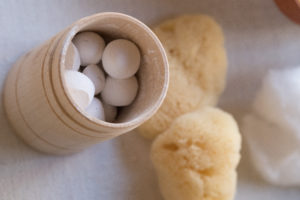
There are several recipes for face up makeup which basically consist of lead white mixed with an oily or watery liquid, in parts with wax or mucilage standard arabic to make a meliorate consistency and make the makeup storable. I particularly liked one where the lead is mixed with rose water and formed into beansized little balls which can exist dissolved with rose water to apply. A nice idea that is a form of makeup storage still in utilise today with rouge and powders. Instead of poisonous atomic number 82 white, we used modernistic white pigments though.
Cheekstain/Blush:
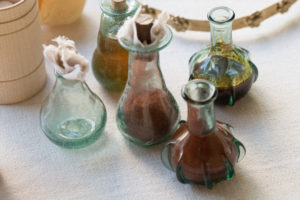
The original recipes mix brazil woods with unlike liquids or greases. We tried it and failed as expected. Brazil woods carmine pigment can not just be solved in h2o or grease, it has to be turned into lac dye (mayhap the author meant just that, brazil wood lac) or mixed with alum. Some of the recipes advise the latter. Simply that makes the dye dangerous for cosmetic use of course. We used ruby ocre and information technology worked perfectly fine. 1 recipe also uses bryony, a plant that causes a skin irritation and would therefor make the skin cherry. Not a great thought to try that out though, folks! Application tin exist done with a bit of material, cotton fiber wool equally suggested in the recipe or just the fingers.
Lip reddish:
One of the recipes suggests to mix bryony with honey and rose water. That would, as in the cheek stain besides crusade a skin irritation and make the lips read. Delight don't try this at home, bryony is poisonous! According to the recipes, you are too supposed to wash your lips with hot water twice a 24-hour interval and accept care of them in club for them to be polish and beautiful. A pretty modernistic take on lip treatments!
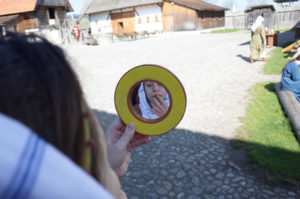
For the application of all these cosmetics, we used a mirror that Nikolaus had made for this occasion after a find from Bavaria.
Sun screen:
Yes, you read right. A beauty-commited woman can already avoid to have her skin destroyed past sunburns and tan.
„ An ointment that the Salernitan women brand that is very good for sunburn and fissures of any kind […] Take ane ounce of lily root, 2 ounces of white lead, mastic and frankincense— of each a half dram—, one dram of camphor, i ounce of animal grease, [and] rose h2o as needed. Allow it be prepared thus: let the lily root, having been cleaned, exist cooked in water, and in one case this is extracted we grind it thoroughly. And we pour in the fat, which has been liquefied on the fire and well strained and cleaned of its salt in society to deliquesce it. Then we put in the white lead, which has been dissolved in the rose water and somewhat pulverized."
It probably is interesting to know, that even today, some sun screens employ white pigment instead of chemical filters. Yes, the paint makes your skin white. Simply information technology likewise shields it from the sun. Y'all tin become rid of the pare burning and tanning UVB rays for some time. Unfortunately information technology does not shield you from the cancer causing and skin aging UVA rays, which is why today, chemical filters are the preferred choice.
Jewellery and clothing:
And of form, a large part of morning routine is getting dressed and putting on jewellery and veils. Here we take all that is precious and expensive from our "Minnekästchen" (an intrically worked jewellery box, often office of the dower): A circlet, prayer chaplet, a pretty fibula, rings, veil pins with pearls on them, a silk belt with silver studs and a knife with an amber handle.

Further data:
Pinterest collection beauty and hygiene
Pilus care and hair dos in the 14th century
Youtube Video and Article on the topic of bath houses in the 14th century
A shaving comb of the 14th century
A medieval mirror – Here is the original
Die Chirurgie des Meisters Henri de Mondeville
Eyebrows, Hairlines, and Hairs Less in Sight – Female person Depilation in Late Medieval Europe, John Friedman, 2018
Excerpts from the Trotula from: https://www.amazon.de/Trotula-Translation-Medieval-Compendium-Medicine/dp/0812218086
Textual sources from "The book of the civilised human", 13th century
Bathing in the center ages
Related Posts
The post-obit posts might interest you too:
Source: https://wh1350.at/en/clothing/medieval-cosmetics-and-beauty-routine/
Posted by: gibbonsfescithavers.blogspot.com
0 Response to "How Did The Middle Ages Makeup"
Post a Comment